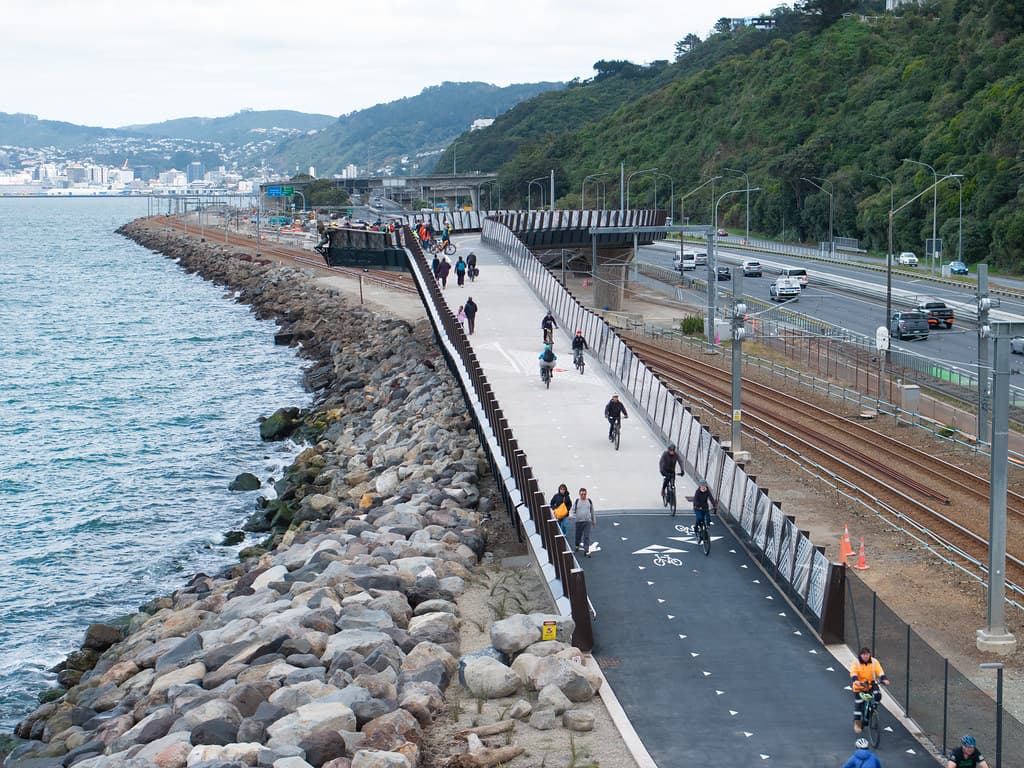
Te Ara Tupua: a first look at the data
Te Ara Tupua opened on 16 May 2026, a Saturday. The 7km shared walking and cycling path runs along Wellington Harbour's foreshore from Petone to Ngauranga, replacing a route where cyclists previously rode alongside State Highway 2. An existing sensor at the southern entry to the path (at the base of Ngauranga Gorge where the gorge path meets the Hutt Road Shared Path) has been counting cyclists since July 2024, giving nearly two years of baseline before the path opened.
I've been working through the WCC Vivacity sensor network as a weekend project: 415+ sensors counting cyclists around the city since late 2023. This is what the first week of Te Ara Tupua looks like, and what the wider dataset says about cycling in Wellington. (As someone who's cycle-commuted in Wellington for over a decade, I had a personal stake in this one.)
Te Ara Tupua: the first week
The pre-opening weeks were running around 175–245 cyclists per weekday at this sensor, already higher than the same month in 2025 when the average was 99/day, reflecting broader growth in corridor cycling over the past year. Then on opening Saturday: 2,430 cyclists. Sunday: 2,333. Against a pre-opening weekend baseline of roughly 40–100 per day, that is a 25–30x spike. The three post-opening weekdays (18–20 May) averaged 1,230, about seven times the pre-opening weekday figure.
Pedestrians surged too, though with a slightly different pattern. The pedestrian peak came on Sunday (1,330) while the cyclist peak was Saturday (2,430), possibly a different crowd: cyclists out early on opening day, walkers coming once word spread. Post-opening weekdays saw pedestrian counts average 451, about four times the pre-opening baseline of 112. By the Monday commute, cyclists outnumber pedestrians at this entry point about 3:1, which makes sense given where the sensor sits.
The clearest signal in the dataset isn't at 51673: it's the comparison with sensor 51669, the old northbound lane cyclists (and everyone else) used to reach SH2. The two sensors sat at opposite ends of the same choice point; before the opening, they counted almost identical volumes.
Pre-opening, both sensors averaged around 180 cyclists per weekday. From opening day, 51669 drops to 13, then 8, then settles around 14 per day, a 92% collapse. Meanwhile 51673 averages 1,230 on post-opening weekdays. The cyclists didn't disappear: roughly 165 of the daily riders who were using the old SH2 route are now counted at the Te Ara Tupua entry instead. The remaining 885 or so additional cyclists per weekday appear to be people who weren't on the old route at all.
The network also saw elevated counts city-wide in the days after opening, around 20% above the pre-opening week across existing sensors. Whether that's a halo effect from the path, calmer weather (winds dropped from 30–40 km/h to noticeably lighter conditions), or both, can't be determined from five days of data.
It's early days for Te Ara Tupua and early days for this analysis. The sensor data will keep accumulating, and the picture will become clearer over the coming months. I'll revisit it as the dataset grows.
Cycling in Wellington is growing
For context on where Te Ara Tupua lands: the wider sensor network shows cycling in Wellington has been growing steadily across all seasons. All figures normalised by active sensor count: the network expanded from about 113 sensors at the start of 2024 to 383+ by late 2025, so raw totals aren't comparable without that adjustment.
The year-on-year growth is visible in every season, but the size of the gain varies depending on which season you look at.
Two things stand out. Autumn is actually the peak cycling season, not summer: school holidays and heat probably push the commuter-dominated autumn numbers above December–February. And winter shows the strongest year-on-year growth at +28% (74.3 to 95.4), while summer gained only 5%. Winter cyclists are the committed ones; seeing that cohort grow that fast says something about how cycling in Wellington is changing. March 2026 at 3,745 cyclists per sensor is the highest single month in the dataset.
Rain and cycling
Not a surprising finding, but it's cleanly quantifiable. Joining daily rain totals from Open-Meteo's Wellington station with daily cyclist counts gives a clear dose-response relationship.
A 10–20mm rain day (not unusual for Wellington) is associated with 39% fewer cyclists than a dry day. By 20mm+ the drop reaches 43%. Wellington doesn't actually get many heavy rain days (only 15 in the dataset crossed 20mm), but the effect is steep well below that threshold. The dry vs trace-rain drop alone (113 to 97) is a 14% reduction from what a passing shower does to the numbers.
Wind direction
Wellington's reputation for wind is well-earned, and wind direction has a measurable effect on cycling beyond just "is it windy."
Easterly winds are the best cycling days at 121 cyclists per sensor. South-westerlies are the worst at 85, a 30% gap that in some months is larger than the seasonal difference. Wellington's key commuter routes run roughly northeast-southwest along the harbour, so SW winds blow directly into riders heading into town, while easterlies push them along. Anyone who commutes by bike from the southern suburbs knows this.
The northerly is the interesting one. North winds dominate the dataset at 39% of days, yet northerly days are unremarkable for cycling: roughly middle of the pack at 106. The direction that feels like it should matter doesn't, much.
This dataset is now nearly two and a half years old and still growing. I'll keep analysing it and will write more as the picture develops, particularly as Te Ara Tupua accumulates enough post-opening data to say something definitive about sustained use.
Data sources
Wellington City Council: Vivacity traffic sensor network Cyclist and pedestrian counts from WCC's Vivacity sensor network, available through the WCC open data portal at data.wellington.govt.nz. Search for "traffic counts" or "Vivacity" under the transport category.
Open-Meteo: weather data Historical weather (rainfall, temperature, wind direction) from the free Open-Meteo API at open-meteo.com.
More posts
12 min read
Wellington's Shitsville is real
I used six years of Wellington weather data to fix the rules on Can You Beat Wellington. Turns out some seasons just don't have good days, and Wellington doesn't have 4 seasons.
3 min read
Can you beat Wellington?
"You can't beat Wellington on a good day" Since I've joined a team that is predominately made up of people outside of Wellington, people now say this to me all...
14 min read
What I've learned from 10 years of bike commuting
Around 10 years ago I rode a bike into work for the first time. It wasn't by choice - I had been riding a classic Vespa to and from work, but the muffler had...
Replies
Loading replies…